|
Chicora
Works with City of Columbia to Clean Up Lower Cemetery
Late late year
Chicora completed its report on Lower Cemetery -- Columbia's public cemetery
from the second half of the 19th century through much of the 20th century --
and forwarded a copy to the City of Columbia.

Lower
Cemetery before the City's cleaning
We were excited
that Columbia's City Manager Steve Gantt quickly contacted the Foundation
and wanted to set up a meeting to ensure the cemetery -- which few in the
City realized existed -- was cleaned up and appropriately cared for. In
early 2010 we met with Amy Moore in the City's Historic Preservation Office
as well as Melissa Smith Gentry, Director of Public Works, Sara Hollar,
Superintendent of Forestry and Beautification, and Capt. E.T. Young, who is
in charge of the North District (which includes Lower Cemetery). A
plan was put together to clean up Lower Cemetery and in matter of about a
month and a half the wooded section went from wilderness to nearly
park-like.

Part
of Lower Cemetery during the cleaning efforts.
Efforts are now
underway by Chicora to map the cemetery and ensure that all of the newly
discovered stones are appropriately recorded and transcribed. The City of
Columbia is still working to help ensure that a plan is implemented to
prevent the return of jungle-like vegetation and to help keep the cemetery
safe.
If you'd like
to read the complete Chicora report on Lower Cemetery, it is
available here as a pdf
document.
If you'd like to see the WOLO TV's Hidden Columbia
episode on Lower Cemetery, there are two available:
one
before the City's cleaning of the cemetery and
one
after the cemetery was cleaned up.
Chicora
Publishes work at the
Old Shoolbred Plantation on Kiawah Island
Chicora
archaeologists have just released their report on the excavations at
what is known as the Shoolbred Old Settlement on Kiawah
Island in Charleston County, South Carolina. Found during the
excavations were the remains of six different slave structures in five
different areas of the site. Settlement in this area dates from the
first quarter of the eighteenth century and continued through perhaps
the first quarter of the nineteenth century, providing an exceptional
view of the lives of Kiawah's enslaved African Americans.
The study included detailed faunal analysis of the
collection, as well as extensive information on the artifacts recovered
from the slave settlements. Discussion includes the range of artifacts
that are best explained as part of the slaves' magio-religious world,
such as bits of glass, fragments of brass, and beads. These allow us to
glimpse a part of the hidden dimension of slavery that is rarely
discussed in archaeological investigations.
Read the
conclusions of the study here.
Chicora Conducts
Treatments at Family Cemetery in Colonial Heights, Virginia
While many box tombs are large, with massive ledgers,
some were designed for infants, such as this monument in a Colonial
Heights family cemetery. Chicora conservators found the monument as
little more than rubble, with the box entirely collapsed and the ledger
broken into six different fragments. To make the repair more difficult,
a misguided earlier repair had used ordinary Portland cement mortar.
Some of these earlier repairs had failed, but many were still clinging
tenaciously to the marble. Here are a series of photographs showing the
repair in progress.
Newest
Issue of Monumental Issues, Chicora's Cemetery Conservation
Newsletter Now Available
This issue
includes articles on recent conservation work at the National Park Service
Kings Mountain National Military Park, why conservation costs are
increasing, new information VA military markers (including who may order
them), and a quick review of wood cemetery markers.
Check it today.
Chicora
Quoted in Boston
Globe Article
Chicora's Director, Michael Trinkley
was quoted in the Sunday, November 15 Boston Globe article, "A
Race Against Time to Save History: Tens of Thousands of Gravestones in
New England are Crumbling" by Brian MacQuarrie.
Read the full article here.
Chicora Assists in
the Removal of Burials from St. Johannes Cemetery, Bensenville, Illinois
Chicora archaeologists and
osteologists spent two weeks in Bensenville, Illinois -- just west of
Chicago -- working on the removal of several graves from the St.
Johannes Cemetery.
This cemetery has been in the news for the past
several years as the local community and church fights efforts by
the City of Chicago to acquire the property for the extension of the
O'Hare International Airport runways.
While the efforts are still being
fought in court, Chicora was retained by the Geils Funeral Home of
Bensenville to assist them in the removal of four burials -- two
infants, one 15-year old, and one adult. While the funeral home was
removing a number of other burials in vaults, it was known that these
four were not. Therefore, the funeral home and the families they
represented wanted to be certain that the removal was done with care,
dignity, and respect.

As airplanes landed immediately north of the cemetery
and construction continued within yards to the west, Chicora
archaeologists identified the graves of four individuals -- two infants,
one adolescent, and one adult. Each grave was exposed by a backhoe being
expertly operated by the firm Stark & Son. Then hand excavation began
to slowly remove the fill and expose the human remains.
With the permission of the families, it was possible
to conduct very brief metric and non-metric analysis of the remains
prior to their removal, as well as examine and photograph the casket
hardware and trimmings.
The investigations at St. Johannes
provided an exceptional opportunity to examine the skeletal remains of a
late 19th and early 20th century German farming community. Skeletal
remains were found to be in very good condition, although burial depths
were quite deep. In addition, each of the burials included an
interesting assortment of casket hardware, including short-bar handles,
studs, casket plates and decorations, and even viewing glass. Each of
the caskets was found to be cloth covered Eastern white pine.
The associated report provides detailed information on
the skeletal remains, clothing items, and casket hardware.
Chicora
Provides Forensic
Archaeology Program to SC IAI
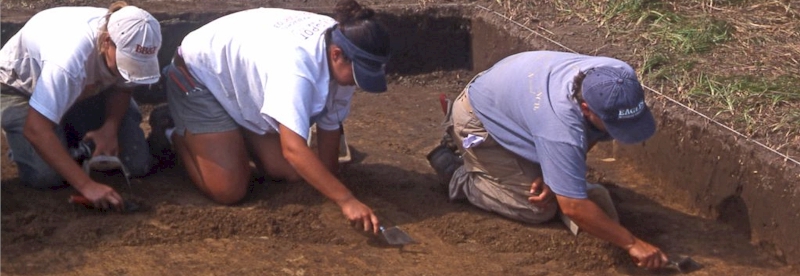
Chicora provided a two-day forensic archaeology
program for the annual meeting of the SC Chapter of the International
Association of Identification. The IAI is the world's oldest and largest
forensic organization. The SC Chapter was organized in 1969.
This year's conference, in Columbia, included a three-day program. The
first day, on forensic anthropology, was provided by Bill Stevens with
the Richland County Coroner's Office. The remaining two days explored
how archaeology can be of critical importance to forensics.
Field exercises were held on the surface recovery of
human remains, as well as the use of proper archaeological excavation
techniques for the recovery of buried remains. Additional segments were
held on the use of the Sokkia total station,
simple forensic entomology, and setting up grids for simple mapping.
Other information ranged from how Munsel Soil Color books can be used in
forensic work, to understanding how declination can affect the use of a
compass.
Over 50 people attended the 3-day event and Chicora
prepared a 75-page manual on the application of forensic archaeology to
crime scenes.

|